Calpe, on Spain's Costa Blanca, is where WorldTour teams come every winter to open their season – and it is also one of the easiest places for an amateur to ride in the cold months. This guide covers the climbs we ride most, three of our favourite routes, the weather month by month and the practical things nobody tells you.
Why ride in Calpe
- A mild climate that stays rideable through autumn and winter.
- Real climbs within an hour of town – Coll de Rates, Tàrbena, the Vall d'Ebo and Bernia – so you can shape every ride around your fitness.
- Quiet inland valleys, vineyards and almond groves, and the sea always in sight on the way home.
- And the Peñón de Ifach, the huge rock above Calpe's harbour, greets you at the start and end of almost every ride.
The climbs we ride most
| Climb | Length | Climbing | Average gradient |
|---|---|---|---|
| Port de la Vall d'Ebo | 7.8 km | 446 m | 6.0% |
| Tàrbena (from Bolulla) | 8.4 km | 410 m | 4.9% |
| Coll de Rates | 6.4 km | 347 m | 5.5% |
| Bernia | 10.9 km | 391 m | 3.5% |
| La Fustera | 4.0 km | 194 m | 4.9% |
Lengths and gradients are the Strava segments we ride, so start and finish points may differ slightly from other sources.
Coll de Rates. The classic of the Costa Blanca: 6.4 km at 5.5% from Parcent, summit at about 630 m. From Calpe it is about an hour of riding (or a little less) to the foot of the climb. At the top you decide: carry on deeper into the mountains, or descend and loop back. Go early in the morning – Coll de Rates is busy with cyclists, and the earlier you start, the more space you have on the descent. You will enjoy it. Coffee stop: Blanca Cafe at the foot of the climb – a favourite stop for cyclists.
Port de la Vall d'Ebo. The hardest climb on this list: 7.8 km at 6% through a string of hairpins, up into the quiet Vall d'Ebo. Steady, long and beautiful – a climb to ride at your own pace.
Tàrbena. From Bolulla the road climbs 8.4 km at almost 5% to the village of Tàrbena, then rolls on towards Coll de Rates. Combine the two for one of the best loops in the region.
Bernia. A long, gentle climb – 10.9 km at 3.5% – around the Serra de Bernia, perfect for steady tempo work.
La Fustera. Short and punchy, close to the coast: 4 km at almost 5%. It comes early on our Cumbre del Sol route and wakes your legs up fast.
Three routes from Calpe (GPX)
All three routes start and finish in Calpe. Download the GPX, load it onto your bike computer and ride.
Cumbre del Sol
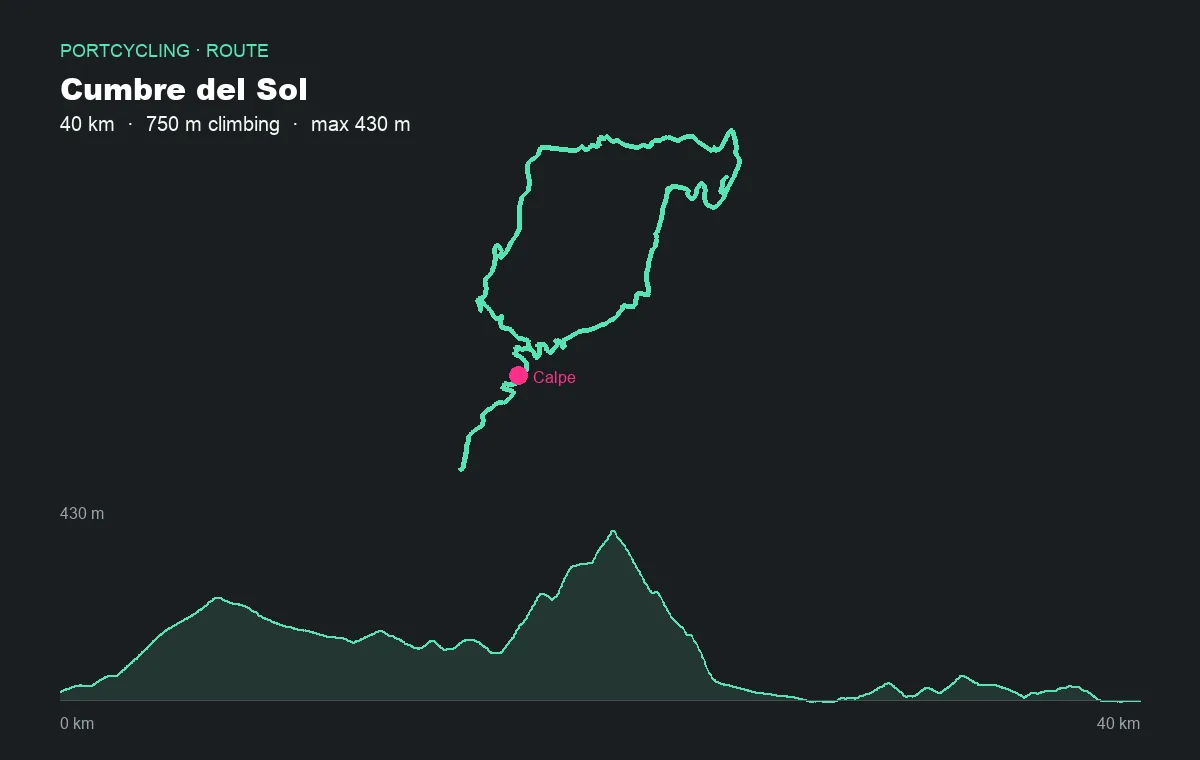
40 km · about 750 m of climbing · highest point 430 m
Calpe → La Fustera → Teulada → Benitatxell → Cumbre del Sol → Moraira → coast road back to Calpe. Short, hilly and always close to the sea – ideal for your first day, a recovery day or a morning before the airport.
Tàrbena & Coll de Rates
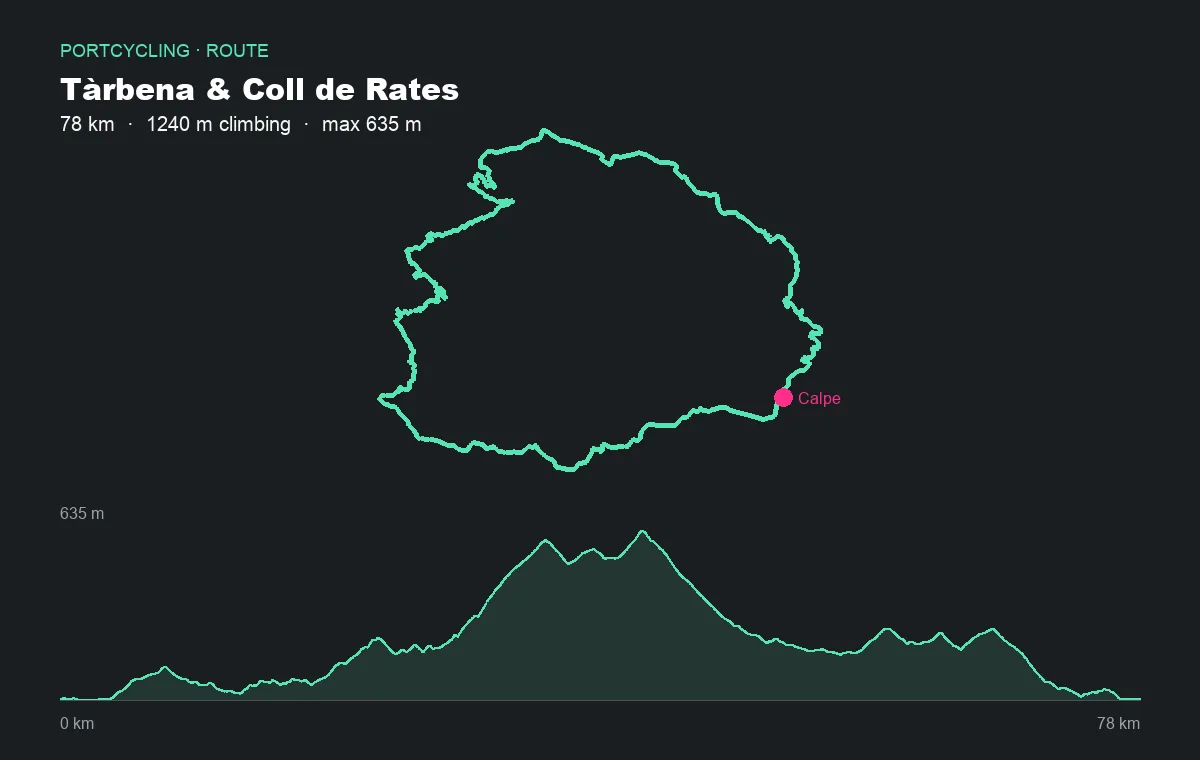
78 km · about 1,240 m of climbing · highest point 635 m
Calpe → Callosa d'en Sarrià → Bolulla → Tàrbena → Coll de Rates → Parcent → Alcalalí → Jalón → Llíber → Senija → Benissa → Calpe. The classic Costa Blanca loop: two real climbs, a fast descent into the Jalón valley and a rolling return to the coast.
Download GPX: Tàrbena & Coll de Rates
Vall d'Ebo
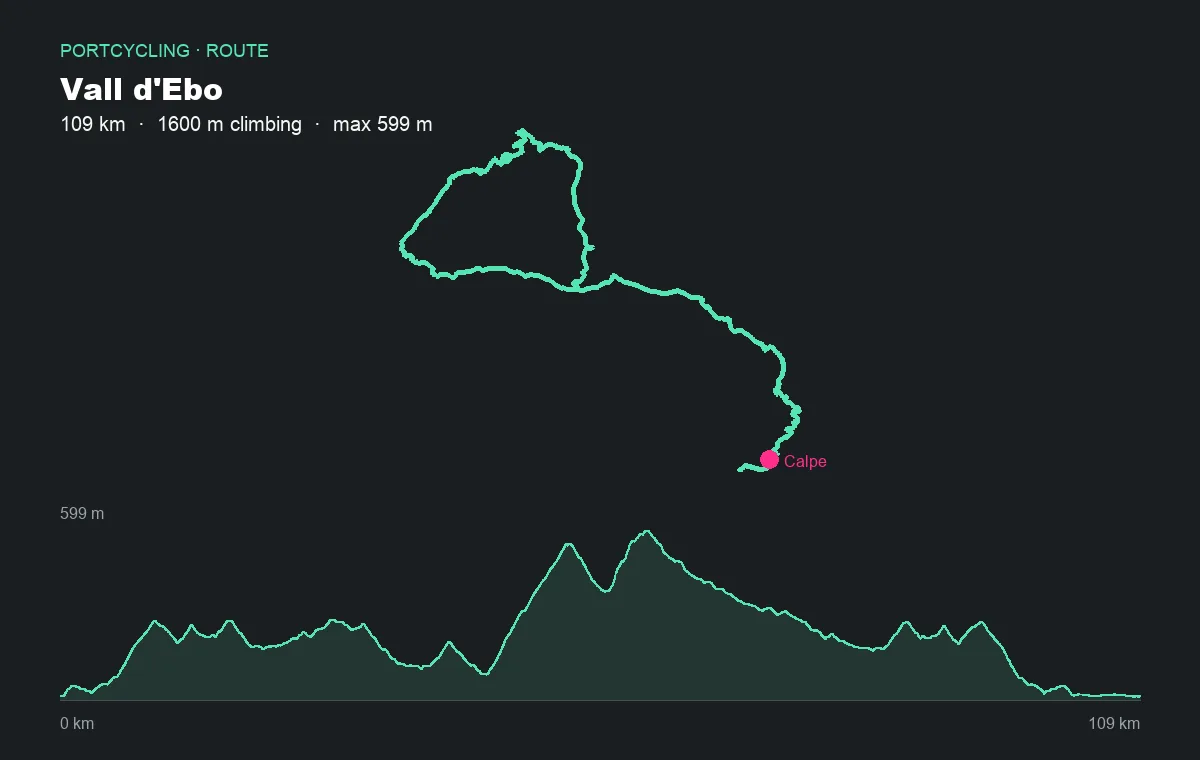
109 km · about 1,600 m of climbing · highest point 599 m
Calpe → Benissa → Jalón → Parcent → Orba → Sagra → Port de la Vall d'Ebo → Vall d'Ebo → Benichembla → Parcent → Jalón → Benissa → Calpe. The big day: a rolling first half through the valleys, the long Vall d'Ebo climb in the middle and a fast return to the sea.
Weather in Calpe by month
| Month | Typical temperature | Riding notes |
|---|---|---|
| January | around 14–17°C, dry and mild | WorldTour teams are in town: training camps, press days, photo shoots |
| February | cooler | still rideable, fewer teams |
| March – September | warm to hot | busy tourist season, especially in July and August – we don't recommend it |
| October | about 22°C on average | warm, full outdoor volume |
| November | 15–20°C | the season quietens down; occasional rain that passes quickly |
| December | 10–18°C | cooler mornings; occasional short showers |
When is the best time to cycle in Calpe?
Autumn and winter are the best time. From October to January the tourist season dies down, accommodation prices drop and the roads become much more comfortable to ride. Temperatures are mostly between 10 and 20°C. You may get some rain, but showers usually pass quickly.
January is special. WorldTour teams are here from the first days of the month – training, holding press conferences and shooting their new kit. You may well find yourself riding the same climbs as the pros.
We don't recommend spring or summer. From spring onwards Calpe fills up with cycling tourists and holidaymakers. The traffic grows, and some roads become genuinely dangerous. If you can choose, come in autumn or winter.
How to get there
Fly into Alicante (ALC). Calpe is about 90 minutes from the airport, and Valencia (VLC) is also an option. If you are joining a Portcycling camp, a group transfer from Alicante or Valencia is available from €70 per person.
Practical tips
- Wind: it can be windy, but nothing like the Atlantic coast of Portugal.
- The sea: the Mediterranean here is warmer than the Atlantic – a post-ride swim is a real option in autumn.
- Coffee: Blanca Cafe – in the centre of Calpe and at the foot of Coll de Rates; 52.11 café; and Musette Café, where you often meet professional riders.
- Start early: the popular climbs get busy with cyclists by mid-morning.
- Watch out: a few very steep sections on the climbs, and the centre of Calpe itself – take it slowly in town.
- Rental and service: you can rent bikes locally – for example Cervélo bikes at Blanca Bikes – and there are workshops if something needs fixing. On our camps a mechanic in our team takes care of repairs.
- Respect the pros. In winter you will share the roads with WorldTour teams. Never jump on a pro rider's wheel without asking, and don't get in the way of their training – they are at work. A nod and a wave are always welcome.
- Bring your own bike if you can: you will get the most out of your training on a bike that fits you perfectly.
Ride it with a coach
If you would rather have the route, the groups and the coaching planned for you, ride these roads with us: Open The Season in January 2027 and Close The Gap in October 2027. Before you come, read our Group Ride Code and the new Spanish rules for cyclists.
FAQ
Is Calpe good for cycling in winter?
What are the best climbs near Calpe?
How far is Calpe from the airport?
Do I need to bring my own bike?
When is the best time to cycle in Calpe?
Keep reading
Spain's New Rules for Cyclists: What Changed on October 1, 2026
Spain changed its traffic rules on October 1, 2026: helmets for all outside towns, 20 km/h slower overtaking, 1.5 m gap and lane position in cities. What it means.
Read →Altitude Training for Cyclists: How Live High, Train Low Works
How altitude training works for cyclists: live high, train low explained, who benefits, the risks and how a Sierra Nevada camp is structured.
Read →How Much Does a Cycling Training Camp Cost? (2027 Prices and What's Included)
What a cycling training camp costs in 2027, what drives the price, what is usually included and what to check before you book.
Read →